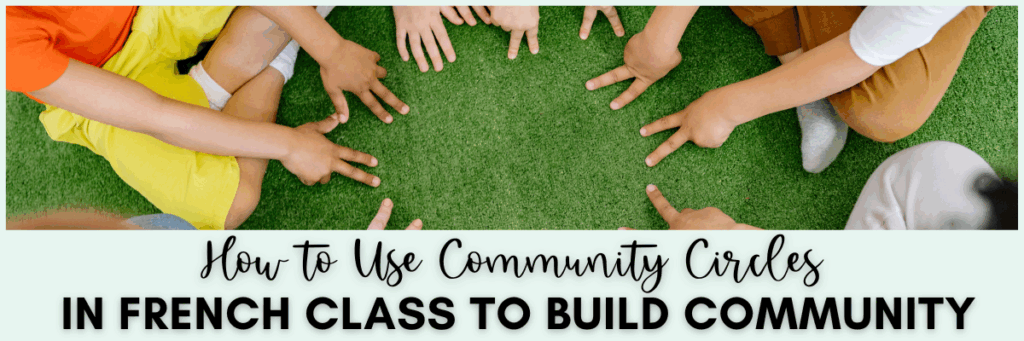
As French teachers, we know that learning a new language out loud can feel intimidating, especially for our Core French or French Immersion students. A strong foundation for French class is essential if we want our students to feel safe, supportive, and willing to take risks to speak French. One simple, but powerful routine you can introduce is community circles in French class. Circles are a great way to building a classroom community where every student has a voice.
What are Community Circles?
Circles are a structured routine where students and staff sit together in a circle and share and listen. This practice originates in Indigenous communities in North America where circles have long been used for relationship-building, decision-making, and healing. They are a practice now widely used in restorative practices and restorative justice in schools as an alternative to traditional, punitive discipline.
Circles for Restorative Practices
Circles can have many different purposes. For example, administrators and teachers can use circles to resolve conflicts.
It’s important to note here that facilitating circles for restorative justice requires training to avoid unintentionally causing harm. Another key point is that participation in this type of circle must always be consensual due to the sensitive nature.
Circles to Support Teaching & Learning
Beyond conflict resolution, French and French Immersion teachers can also use circles to support instruction. For example, circles can be really informative in Social Studies and History classes to reinforce critical thinking, perspective-taking, or even analyzing cause and consequence in relationship to a specific historical event.
In French class, a circle routine can help reinforce vocabulary and provide opportunities for oral communication in a safe and low-pressure way.
Circles to Build Classroom Community
Lastly, circles are a powerful way to build community in the classroom. They create space for students to share their thoughts, connect with one another, and develop trust. For French teachers, this is especially valuable as students are more likely to speak French and take risks when they feel a sense of belonging.
If you are familiar with my work, you will know that I am super passionate about routines in the French classroom. One of my favourite routines is Question du Jour. I think that Question du Jour and circles would work really well together since both routines give students the opportunity to share their voice, practice speaking French in a low-stakes way, and strengthen classroom community.
What grade levels are community circles ideal for?
Community circles can be used across grade levels, from elementary to high school Core French or French Immersion classes. Since I teach high school, this blog post will focus on how circles can support students from Grades 8-12. However, the routine can be easily adapted for younger students as well.
Watch the brief & informative chat with my amazing colleague Maryline to see how she implements community circles in her French Immersion classroom!
Maryline is a superstar! We have been neighbours for the last eight years. For several years now, I have noticed Maryline and her class doing circles at the back of her classroom. It has always intrigued me.
Today I am bringing in Maryline to tell you all about circles in her French Immersion classroom.
Helpful tools
If you’re looking for more support and guidance before you facilitate your first circle, here are some helpful tools.